SEO Is Not Dead — It Just Got Smarter: The Complete Guide to SEO, AEO, and GEO for Indian Businesses in 2026
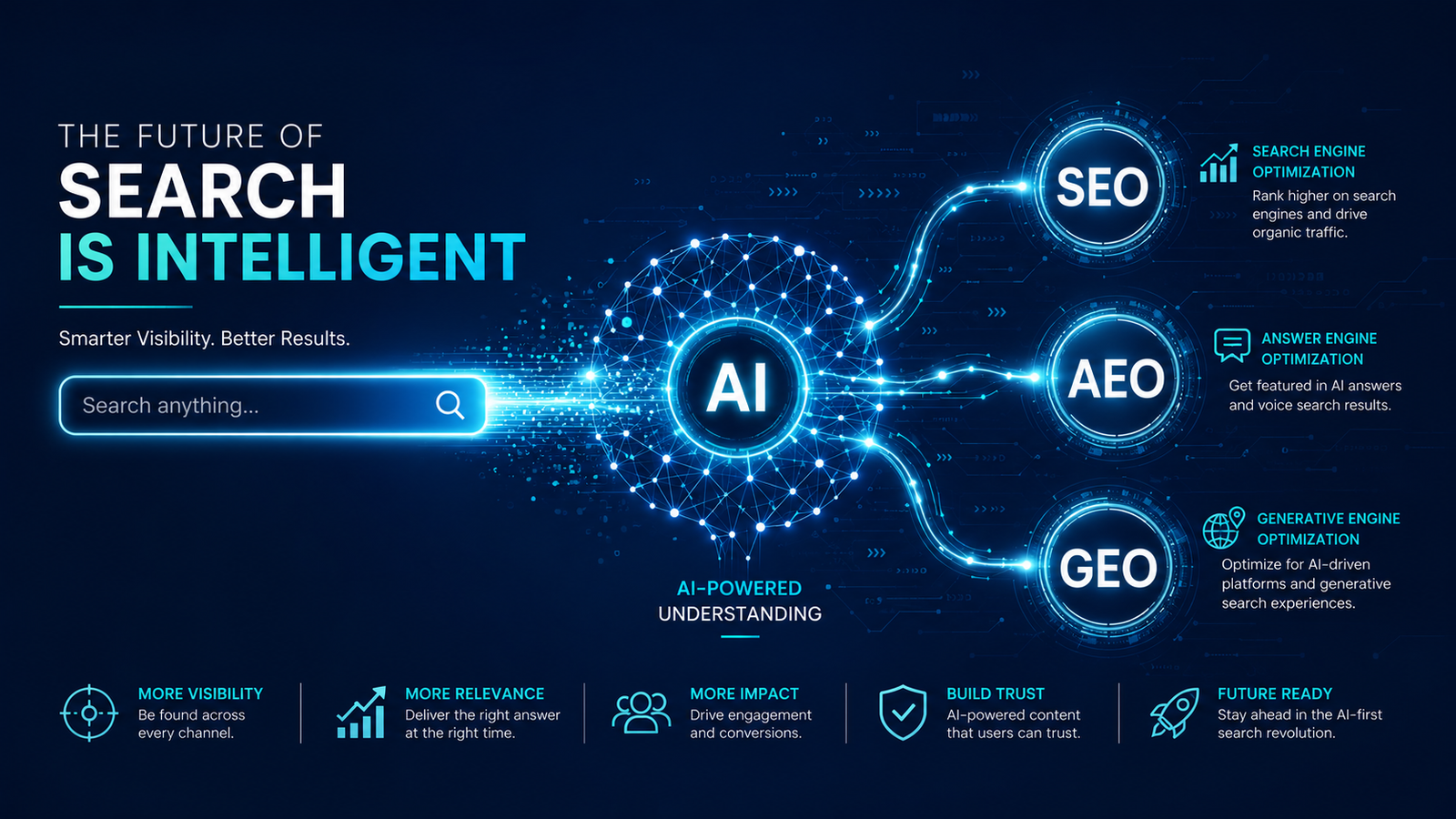
SEO, AEO, and GEO are three complementary search visibility strategies that every Indian business needs in 2026. Traditional SEO gets you ranked on Google. Answer Engine Optimization (AEO) gets your content cited in AI Overviews and voice search results. Generative Engine Optimization (GEO) gets your brand mentioned by ChatGPT, Perplexity, and Gemini. All three are required. None can replace the others.
What Has Changed in Search in 2026
Search engine visibility in 2026 is no longer about ranking in a list of ten blue links. It is about being cited inside AI-generated answers across multiple platforms simultaneously.
Google now processes 14 billion search queries every single day (SparkToro, 2025). Of those, searches that trigger AI Overviews now result in zero clicks to any website 83% of the time, up from 60% for traditional queries (BrightEdge, 2025). At the same time, ChatGPT processes 2.5 billion prompts daily, and 65% of those prompts qualify as search intent (Jasper, 2026). Perplexity, Google Gemini, and Microsoft Copilot are adding hundreds of millions of additional AI-driven queries every month.
This means your business must now be visible in three distinct places: traditional Google search results, AI-generated answer boxes, and conversational AI tools. Each requires a different optimization strategy. Together, they form what Codecura Technologies calls the complete search visibility stack: SEO + AEO + GEO.
What Is SEO in 2026? (And Why It Is Still the Foundation)
Search Engine Optimization (SEO) is the practice of improving a website’s visibility in Google’s organic search results through keyword optimization, technical health, backlink building, and content quality.
SEO remains the essential foundation of all digital visibility. Without strong SEO, neither AEO nor GEO will work — because AI systems use the same authority and relevance signals that Google’s traditional algorithm uses to evaluate content credibility.
For Indian SMEs, local SEO is the single highest-impact starting point. Google Business Profile optimization, local citation building, and geo-targeted content can generate direct leads within 30 to 60 days. Tier-2 cities like Kanpur, Lucknow, and Agra represent particularly strong opportunities because national-level competition for local search terms remains relatively low compared to Delhi or Mumbai.
Key SEO components that remain non-negotiable in 2026 include technical website health, Core Web Vitals performance, mobile-first indexing compliance, keyword-to-intent mapping, on-page optimization, and a structured backlink profile from relevant Indian industry sources.
What Is AEO — Answer Engine Optimization?
Answer Engine Optimization (AEO) is the practice of structuring content so that AI-powered search features — including Google’s AI Overviews, featured snippets, and voice assistants — extract and present your information directly to users as a cited answer, with or without a click to your website.
Traffic arriving via AI citations converts 4.4 times better than traditional organic search traffic, because users arriving via AI citations have already validated your content as authoritative. This means AEO visibility, even when it generates zero clicks, still builds brand authority that converts at a higher rate when the user does eventually visit your site.
AEO works through five specific content and technical techniques:
- Direct answer blocks. Every section must open with a clear, concise answer to the question that section addresses — not with contextual background. AI engines evaluate the first one to two sentences of every section to decide whether to cite it.
- Question-based headings. Headings should be phrased as questions your customers actually ask — “What is GEO?” rather than “Introduction to GEO” — because this matches the natural language queries users type into voice assistants and AI tools.
- FAQ sections with structured answers. FAQ content maps directly to how users query AI engines. Each FAQ answer should be 50 to 150 words — enough to be authoritative, brief enough to be extractable — with the direct answer in the first sentence, supporting context in sentences two and three, and a specific example or data point last.
- Schema markup. FAQPage schema, Article schema (BlogPosting), and LocalBusiness schema tell AI engines exactly what your content is, who wrote it, and what questions it answers. FAQPage schema marks up your FAQ section so AI engines can directly extract question-answer pairs — this is one of the highest-impact AEO optimizations because FAQ content maps directly to how users query AI engines.
- E-E-A-T signals. Author credentials, publication dates, genuine customer reviews, and verifiable case study results all signal to Google and AI systems that your content comes from a real expert — not a content farm.
For Indian businesses specifically, AEO is the strategy that wins voice search. India is a smartphone-first market where Hindi-language voice queries on Android are growing fastest in Tier-2 and Tier-3 cities (Google for India, 2025). When someone asks their phone “Kanpur mein sabse acchi digital marketing agency kaun si hai,” Google’s voice assistant pulls its answer from AEO-optimized content. If your competitor has structured their content this way and you have not, they get named and you do not.
What Is GEO — Generative Engine Optimization?
Generative Engine Optimization (GEO) is the practice of structuring your brand’s content, authority signals, and cross-platform presence so that AI tools — including ChatGPT, Perplexity, Google Gemini, and Microsoft Copilot — cite, recommend, and mention your business when users ask questions relevant to your industry.
The overlap between top Google links and AI-cited sources has dropped from 70% to below 20% and this gap is growing as AI systems develop their own preferences for which sources to cite. This is the most important statistic in digital marketing in 2026. It means a business can rank on page one of Google and still be completely invisible when someone asks ChatGPT for a recommendation in the same category.
GEO is built on five core signals that AI systems use to decide which brands to cite:
Evidence-backed authority. Content incorporating authoritative citations, direct quotations, and relevant statistics achieves 30 to 40% higher visibility in generative engine responses (Princeton University and Georgia Tech, 2025). Original research, proprietary data, and expert opinions are the content types AI systems most frequently cite.
Fact density. A pillar article should carry one statistic, percentage, or numerical data point every 150 to 200 words, each linked to its primary source. This is the single strongest signal a page can send that it is research-backed rather than speculative.
Entity clarity. AI systems identify entities — brands, people, organizations, services — and assess how consistently they appear across multiple sources. Your business name, founder name, location, and service descriptions must be stable and consistent across your website, Google Business Profile, social media, and any media mentions.
Cross-platform presence. AI engines assess authority holistically. Consistent information across reviews, social media, industry publications, and your own site strengthens citation likelihood.
Content freshness. 50% of content cited in AI answers is less than 13 weeks old. AI systems heavily weight recently updated, current-year content over older evergreen articles. Adding a “What changed in 2026” section to existing articles is one of the fastest GEO improvements any business can make.
The Complete Formula: SEO + AEO + GEO
These three disciplines are not alternatives — they are sequential layers that each build on the one below.
Strong SEO gets your content indexed, discovered, and ranked. AEO adds the structure and clarity AI systems need to extract and cite your answers in Google’s AI Overviews and voice results. GEO adds the authority signals, fact density, and cross-platform presence that make ChatGPT, Perplexity, and Gemini trust you as a source worth naming.
Structured pages earn a 2.8 times citation lift compared to unstructured equivalents. When you combine proprietary data with clear heading hierarchy and schema markup, you give answer engines both a reason to cite you and a format that makes extraction easy. AirOps
For Indian SMEs, the competitive window is right now. Most local competitors are still running 2020-era SEO strategies. A business that builds all three layers today — technical SEO foundations, AEO content structure, and GEO authority signals — will be ahead of both local and national competitors in AI-powered search results through 2027 and beyond.
How Codecura Technologies Builds Your Complete Visibility Stack
Codecura Technologies LLP, headquartered in Kanpur, Uttar Pradesh, delivers full-stack search visibility for Indian businesses across all three optimization layers.
Our SEO service covers technical audits, keyword research aligned to Indian search intent, Google Business Profile optimization, local citation building for UP and pan-India markets, and on-page content optimization. Our AEO service restructures your existing content with direct answer blocks, question-based headings, FAQ sections, and FAQPage and Article schema markup validated through Google’s Rich Results Test. Our GEO service builds the long-term authority infrastructure — data-backed content, expert-authored articles, cross-platform entity consistency, and proprietary insight pieces — that AI tools need to trust and cite your brand over time.
We serve clients in Kanpur, across Uttar Pradesh, in the UAE, and in the United States. Our approach combines local market understanding with global best practices, because local SEO, local voice search queries, and local authority signals are what generate real leads for the businesses we work with.
Frequently Asked Questions
1. What is the difference between SEO, AEO, and GEO?
2. Is SEO still relevant in 2026?
3. How long does it take to see results from AEO?
4. What is a zero-click search and why does it matter for Indian businesses?
5. Which AI platforms should Indian businesses prioritize for GEO?
6. Does Codecura Technologies offer AEO and GEO services?
7. What is E-E-A-T and why does it matter for AI search?
8. How do I know if my content is being cited by AI tools?
Codecura Technologies LLP is a result-driven digital marketing agency headquartered in Kanpur, Uttar Pradesh, with clients across India, the UAE, and the USA. We specialize in SEO, AEO, GEO, web development, social media management, paid advertising, and business consulting. Visit codecuratechnologies.in to request your free SEO, AEO, and GEO audit.